Wednesday, May 16, 2012

our balkanized, inefficient and anachronistic education system


The best thing about the school property tax cap is that it undermines the integrity of our balkanized, inefficient and anachronistic education system. A system that separates kids based on illogical and superficial political divisions established in an era when horses pulled farmer’s carts home after market, and white men exercised a political and economic monopoly. An educational system that supports an agricultural society not a nano-technological one, because it limits the days devoted to book learning to 180, or 49% of the year. All of these issues, and more, compound to create a very dysfunctional K-12 educational system across this country, and in fact, the problems are so dire that that the Council on Foreign Relations recently concluded that they “constitute a very grave national security threat facing this country[1]

This country needs to modernize our education system by eliminating antiquated structures and ensure that all students, regardless of the wealth of the family that they were born into, have outstanding teachers, campuses and resources. However, across New York State “school districts have overwhelmingly complied with the spirit of the tax cap, unfortunately to the detriment of their educational mission and financial stability,” said NYSASBO Executive Director Michael
J. Borges.[2]

The Schenectady School Board is no exception, and while the Superintendent and the Board stated that the budget overwhelmingly approved by the voters “preserves the full range of instructional programs and services so critical to the success of our students”[3], they are being either disingenuous or dangerously naive about education.

First, the 2012-13 Schenectady School Budget will undercut pre-k education by reducing funds for supplies and eliminating a teacher. Research shows that intensive instruction for pre-k kids generates life long rewards for the student and society, but neglecting early education decreases the nation’s economic productivity and limits possibilities for children. The need is vast for rigorous early education. For example, one study that found that the vocabularies of kids from low-income families were 50% smaller than kids from upper and middle-income families.[4]  What the district saves in this budget cycle on short-changing 4 year-olds will cost the school district and society many times that amount in the future.

Second, the Board will destroy, for at least one year, one of the true bright spots in the district when it reorganizes the Magnet schools. K-8 schools are advantageous for many reasons: continuity for students, collaboration amongst teachers, stable school culture, and a sense of community for all. 

By ripping away all of the kindergartens and putting them in one place, away from other kids in the same developmental stage, the people will save a few dollars. However, this is financially myopic and contrary to best educational practice. Part of education is foreword looking, a sense of transition, and the formation of possibilities. Without older students modeling academic growth – and possibly tutoring them- the kindergartners will loose valuable visions of development.  Furthermore, if the kindergarteners need advanced enrichment, where will they go?

The K-8 model will have the K removed and as a result, students arriving as first graders will not have the benefit of having teachers know them; they will not know the physical space, they will not know the culture and possibilities possible at the school; the unnecessary transition to a new environment will impede the education of many kids. First grade education, which is the foundation for future growth, will suffer as a result.

The ratified 2012-13 budget will transfer 155 students into the magnet schools, and this will effectively curtail the 1-8 into a 1-6.  The introduction of masses of new students into an established school will be destabilizing. Teachers will not know the students, and students will not know the school and all of its characteristics. These new students will be disoriented themselves and they will undermine the educational balance of the established school community. The 7th and 8th grades, now weighted beyond their natural structural size, will effectively be a mini-middle school.

This one-year budget will undermine so much of the stability generating and community building enabled by public schools. The much-lauded K-8 magnet schools will be dead, pre-schoolers will be stifled, and kindergartners and some middle schoolers will not have a stable learning community. We will be worse off as a result.

The vast majority of teacher slashing and education depleting school budgets across NYS passed on May 15th, and this summons the specter of an ‘educational insolvency’ that the State Education Commissioner John King has raised[5]. Our country deserves better than austerity education for our children. However, by undermining the current system perhaps people will reflect upon how artificially fractured, unjust, antiquated and weak our education system is, and strive to create a modern and dynamic structure that will enrich all children and make our country safe and vibrant.


Tuesday, February 28, 2012

Engineering Design for Pedestrians

It is essential that Schenectady incorporate the best pedestrian engineering design on all roads with heavy pedestrian and potentially heavy bicyclist traffic.


There is a discussion today in the Times about pedestrian and biking safety. One of the commentators addresses design, 2 focus on enforcement, while the last commentator reminds us that bikers need to follow the laws as well.  The design essay mentions raised pedestrian crosswalks; he probably means bridges over traffic, but changing the texture of the street before and on a cross walk would also slow down motorists and make them aware of pedestrian crossings.  He also cites Complete Streets an organization that advocates for streets designed for all, not just cars. http://www.completestreets.org/complete-streets-fundamentals/resources/

Engineering design for pedestrians:


Also a book in pdf from the Federal Highway Administration: 

the chapter on crosswalks with plenty of good ideas


It Starts With Better Design
Peter Calthorpe
Peter Calthorpe is the author of "Urbanism in the Age of Climate Change" and a principal at the planning firm Calthorpe Associates in BerkeleyCalif.
FEBRUARY 27, 2012
Suburbs have reduced pedestrian and bike injuries by largely eliminating pedestrians and bikers a solution, but not a great one. Streets there are designed for cars, and other users are secondary. However, in New York City, pedestrians remain a powerful reality, and bikers are making a comeback. Policy and design must be combined to balance these groups’ claims on public space. “Complete Streets” — the idea that roads should be balanced in use and provide for user safety — is being pioneered in the city and supported by the federal Department of Transportation.
The answers are simple: create safe bike lanes, generous pedestrian spaces, protected crossings and narrow car lanes.
The “broken windows” strategy aims to change the character of places by policing a range of ambient activities. I agree that we need to intensify policing of auto infractions and make consequences for dangerous behavior more intense. But these policing efforts should be complemented by redesign of streets and reversal of the practice that has driven suburban land use: the more we design for cars, the less walkable, bikeable and enjoyable our streets become — and therefore the more we want to drive.
The answers are simple: create safe bike lanes, generous pedestrian spaces, protected, visible, and short crossings and narrow car lanes to slow traffic. Some Chinese cities are attempting to bring back bikers by building barriers to protect bike lanes, and in many European cities bike lanes are designated by much more than painted lines.
Another key to safety is slowing cars at intersections. Raised pedestrian crossings and “bulb-outs” that shorten crossings are good examples. Even more radical is the notion of auto-free streets: boulevards just for transit, bikers and pedestrians. New York City has the density and mix to justify many of these strategies.
Close to 40 percent of all land in our cities and towns is devoted to streets. They provide for much more than mobility: they carry essential utilities, they provide access for police and fire protection, and perhaps most important, they provide the ground for the social interaction that makes cities civil, exciting and convivial. Streets are the bedrock that makes cities great places to live. How we design and use them is a profound expression of who we are.

Thursday, February 23, 2012

Create Cities for People, Not Cars

From what I have read about the much touted Erie Boulevard redevelopment- that includes no running water- it will not satisfy the new NYS legal requirements that all newly rehabbed streets include extensive pedestrian and bicyclist accommodations.

More can be done on Erie Boulevard, and all over Schenectady, to prevent senseless deaths. 

Create Cities for People, Not Cars

Thursday, July 21, 2011

Too Safe?

This article makes a point that playgrounds should have age specific apparatus on them, but that 
does not negate the need for playgrounds to be safe.  I suspected when I advocated for the installing of
mulch at Riverside playground in Schenectady that there would be an affect on the behavior of people using
the playground.  Just as there are data that demonstrates that people who use car-seats have more accidents
than people who do not use car-seats for their children, and kids are statistically safer -according to one study- with out 
car seats.  Would you not want a seat-belt or a car seat for your child? 
 Soft falling surfaces prevent serious injuries as http://schenectadyplaygrounds.blogspot.com/2011/05/central-park-injury.html details.  I suspect that data that shows kids having more injuries on safe surface playgrounds did not account for a few exogenous variables.  Did the improved playground induce more kids to play at the playground?  If so, the results would be biased.  What age kids were injured? I suspect that safe surfaces on playgrounds minimize injuries on younger children, while potentially - I am not convinced at the statistical soundness of the data- increasing the injuries for older children.  
Playgrounds are training grounds for forests, mountains, cannons, and glaciers and they should be challenging and rewarding, but they should not unnecessarily dangerous.  


July 18, 2011

Can a Playground Be Too Safe?


When seesaws and tall slides and other perils were disappearing from New York’s playgrounds, Henry Stern drew a line in the sandbox. As the city’s parks commissioner in the 1990s, he issued an edict concerning the 10-foot-high jungle gym near his childhood home in northern Manhattan.
“I grew up on the monkey bars in Fort Tryon Park, and I never forgot how good it felt to get to the top of them,” Mr. Stern said. “I didn’t want to see that playground bowdlerized. I said that as long as I was parks commissioner, those monkey bars were going to stay.”
His philosophy seemed reactionary at the time, but today it’s shared by some researchers who question the value of safety-first playgrounds. Even if children do suffer fewer physical injuries — and the evidence for that is debatable — the critics say that these playgrounds may stunt emotional development, leaving children with anxieties and fears that are ultimately worse than a broken bone.
“Children need to encounter risks and overcome fears on the playground,” said Ellen Sandseter, a professor of psychology at Queen Maud University in Norway. “I think monkey bars and tall slides are great. As playgrounds become more and more boring, these are some of the few features that still can give children thrilling experiences with heights and high speed.”
After observing children on playgrounds in Norway, England and Australia, Dr. Sandseter identified six categories of risky play: exploring heights, experiencing high speed, handling dangerous tools, being near dangerous elements (like water or fire), rough-and-tumble play (like wrestling), and wandering alone away from adult supervision. The most common is climbing heights.
“Climbing equipment needs to be high enough, or else it will be too boring in the long run,” Dr. Sandseter said. “Children approach thrills and risks in a progressive manner, and very few children would try to climb to the highest point for the first time they climb. The best thing is to let children encounter these challenges from an early age, and they will then progressively learn to master them through their play over the years.”
Sometimes, of course, their mastery fails, and falls are the common form of playground injury. But these rarely cause permanent damage, either physically or emotionally. While some psychologists — and many parents — have worried that a child who suffered a bad fall would develop a fear of heights, studies have shown the opposite pattern: A child who’s hurt in a fall before the age of 9 is less likely as a teenager to have a fear of heights.
By gradually exposing themselves to more and more dangers on the playground, children are using the same habituation techniques developed by therapists to help adults conquer phobias, according to Dr. Sandseter and a fellow psychologist, Leif Kennair, of the Norwegian University for Science and Technology.
“Risky play mirrors effective cognitive behavioral therapy of anxiety,” they write in the journal Evolutionary Psychology, concluding that this “anti-phobic effect” helps explain the evolution of children’s fondness for thrill-seeking. While a youthful zest for exploring heights might not seem adaptive — why would natural selection favor children who risk death before they have a chance to reproduce? — the dangers seemed to be outweighed by the benefits of conquering fear and developing a sense of mastery.
“Paradoxically,” the psychologists write, “we posit that our fear of children being harmed by mostly harmless injuries may result in more fearful children and increased levels of psychopathology.”
The old tall jungle gyms and slides disappeared from most American playgrounds across the country in recent decades because of parental concerns, federal guidelines, new safety standards set by manufacturers and — the most frequently cited factor — fear of lawsuits.
Shorter equipment with enclosed platforms was introduced, and the old pavement was replaced with rubber, wood chips or other materials designed for softer landings. These innovations undoubtedly prevented some injuries, but some experts question their overall value.
“There is no clear evidence that playground safety measures have lowered the average risk on playgrounds,” said David Ball, a professor of risk management at Middlesex University in London. He noted that the risk of some injuries, like long fractures of the arm, actually increased after the introduction of softer surfaces on playgrounds in Britain and Australia.
“This sounds counterintuitive, but it shouldn’t, because it is a common phenomenon,” Dr. Ball said. “If children and parents believe they are in an environment which is safer than it actually is, they will take more risks. An argument against softer surfacing is that children think it is safe, but because they don’t understand its properties, they overrate its performance.”
Reducing the height of playground equipment may help toddlers, but it can produce unintended consequences among bigger children. “Older children are discouraged from taking healthy exercise on playgrounds because they have been designed with the safety of the very young in mind,” Dr. Ball said. “Therefore, they may play in more dangerous places, or not at all.”
Fear of litigation led New York City officials to remove seesaws, merry-go-rounds and the ropes that young Tarzans used to swing from one platform to another. Letting children swing on tires became taboo because of fears that the heavy swings could bang into a child.
“What happens in America is defined by tort lawyers, and unfortunately that limits some of the adventure playgrounds,” said Adrian Benepe, the current parks commissioner. But while he misses the Tarzan ropes, he’s glad that the litigation rate has declined, and he’s not nostalgic for asphalt pavement.
“I think safety surfaces are a godsend,” he said. “I suspect that parents who have to deal with concussions and broken arms wouldn’t agree that playgrounds have become too safe.” The ultra-safe enclosed platforms of the 1980s and 1990s may have been an overreaction, Mr. Benepe said, but lately there have been more creative alternatives.
“The good news is that manufacturers have brought out new versions of the old toys,” he said. “Because of height limitations, no one’s building the old monkey bars anymore, but kids can go up smaller climbing walls and rope nets and artificial rocks.”
Still, sometimes there’s nothing quite like being 10 feet off the ground, as a new generation was discovering the other afternoon at Fort Tryon Park. A soft rubber surface carpeted the pavement, but the jungle gym of Mr. Stern’s youth was still there. It was the prime destination for many children, including those who’d never seen one before, like Nayelis Serrano, a 10-year-old from the South Bronx who was visiting her cousin.
When she got halfway up, at the third level of bars, she paused, as if that was high enough. Then, after a consultation with her mother, she continued to the top, the fifth level, and descended to recount her triumph.
“I was scared at first,” she explained. “But my mother said if you don’t try, you’ll never know if you could do it. So I took a chance and kept going. At the top I felt very proud.” As she headed back for another climb, her mother, Orkidia Rojas, looked on from a bench and considered the pros and cons of this unfamiliar equipment.
“It’s fun,” she said. “I’d like to see it in our playground. Why not? It’s kind of dangerous, I know, but if you just think about danger you’re never going to get ahead in life.”


Tuesday, May 17, 2011

Central Park Injury

Our son fell a few feet off a ladder in Schenectady's Central Park and hit an exposed and protruding tree root.  It severed his bone.  

The hack surgeon had to place 3 pins in his arm.  

My son on hard core narcotics in the slowest ER in the world, Ellis Hospital. 
Because the quacking hack, Dr. Robert Cooley,
  refused to put a hard cast on, T's falls caused his arm to become more misaligned.  Today his arm is not straight, but it is more than not straight, it is obviously crooked.  

It took me a year to be able to go back to the site where T fell; I took this picture.  If he had fallen on just dirt he might have just gotten a minor injury, if he had fallen on mulch - he would have bounced back up- and he would be perfect today- mentally and physically. 
The City of Schenectady has done nothing to improve the safety of the playground.

This event has had profound impacts upon our family.  T's personality changed subtly after the fall- he is more likely to cry and be scared.  His arm is obviously crooked, and it pains me every time I look at it.  The fall has stressed my marriage, and it deteriorated my mental and physical health for a few months following the incident.  It is still a very difficult event for me to ponder, it stresses and depresses me.  

*Update
I took my son to a pediatric bone doctor in Albany who operated out of a recommended clinic for a through examination and he told me that he would have placed my son in a hard cast after a few days after the surgery.  Something that was not done by Dr. R..D...  He told me that in all the years of his practice he never had a bone set like he saw in my son. On the check out paper in the location for diagnosis he wrote "Deformed Elbow".  

 Dr. Robert Cooley operated on my son after he broke his arm. He refused to put him in a hard cast. My 2.5 year old son subsequently fell on his arm and it was knocked out of place. It did not heal straight. Dr. Cooley did not think this was a problem. "It will remodel" he said on numerous visits, consistently refusing to take responsibility for his failure. I brought my son to a different doctor and he diagnosed him with a "deformed arm". This second doctor said he would have never sent a young child home without a hard cast. It has been many years and his arm only looks worse. Choose Dr. Cooley if you want incompetence and future deformities

Friday, March 18, 2011

Joseph C. Yates

On the second floor of the Capitol Building, in Albany, reside the former Governors of New York State.  Governor Andrew Cuomo recently opened the hall to the general public.  It is an excellent gallery of governmental portraiture.  Joseph C. Yates' portrait stands out because of the ungiled frame that crops the painting in an unflattering manner which also suggests portions of the painting are covered, like his hand.  

There is no light on this Governor, but he really does not need one, and other Governors' portraits do not have lights.  

Governor Yates' nameplate is simple, but uninformative.  It is fitting to have date of office, hometown, and perhaps other titles held on the nameplate.  

The Stockade Association could work with the State to provide for a suitable presentation of Governor Yates.
*Click on any image to view larger version*


Wednesday, November 3, 2010

Mrs. Elizabeth Van Rensselaer Gillette's Legislative Record

Update: When this was first developed, one was able to double click on the photos of the bills to read the text. Currently, google has changed their photo viewing architecture to disable that feature, therefore making it impossible to read the bills. However, there are summaries of the bills in the commentary.

This is Dr. Gillette's complete legislative history.  The full text of all eight of the bills she introduced in the NYS Assembly are below.   


These pages referencing Dr. E. V. Gillette are taken from the NYS 1920 Redbook, a publication of NYS government that explains who is in state government and what they have done. 


This page lists the eight bills that she sponsored.  All of the bills she sponsored are solely sponsored by her.  In the few number of bills that I read from the 1920 session, all of them had single sponsors.  The modern fashion to have multiple, even dozens, of sponsors to a bill does not seem to have been in vogue then.  None of the bills she introduced were enacted into law.  However one bill was passed by the Assembly and the Senate, but it was vetoed by the Governor.  

This page gives a brief biography of Dr. Gillette, and her life in Schenectady. 


This is the bill she introduced that passed both houses and was vetoed by the Governor.  It addresses a problem still plaguing Schenectady today, floods.  The premise of the bill is that the State was negligent in the construction of the Vischer's Ferry dam, also known as lock 7, in Niskayuna.  "(N)ot providing said dam with adequate flood gates and devices to operate the same, or in not removing the Rexford dam and aqueduct, or in not breaking up the solid field of ice on the pool formed by this dam, and thereby bringing about a jam of ice... which caused the alleged damages during the months of March and April, nineteen hundred and fourteen."

This is an interesting argument because it examines the root cause of the flooding, it is novel today because it is always assumed that nothing can be done.  In Dr. Gillette's time people were still pondering the most efficient and least harmful dam designs.  I wonder if a solution could be found to this dilemma by modern engineers.  

This bill simply requests $400,000 for the construction of a bridge between Schenectady and Scotia.  It was also introduced, and killed in the Senate. 

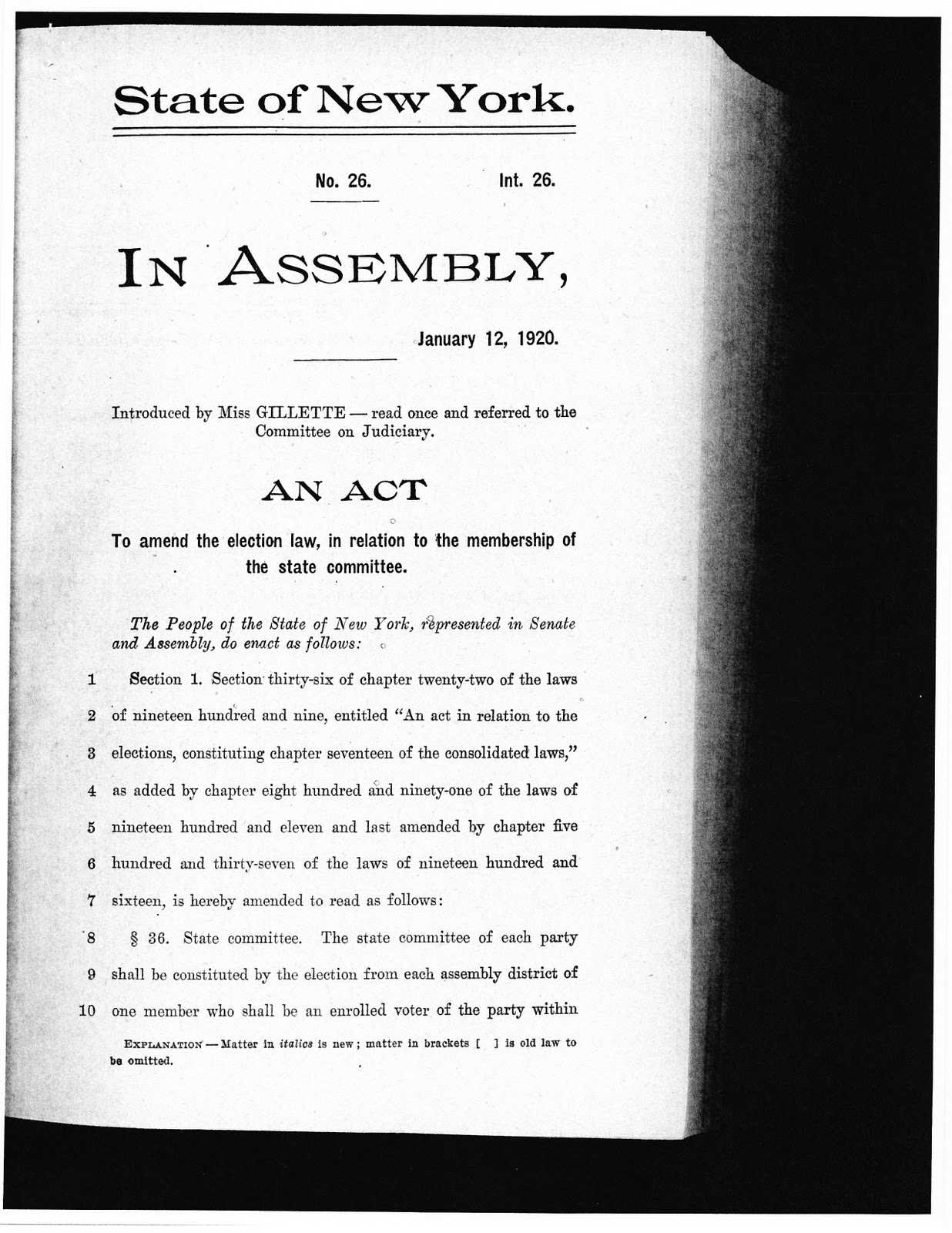
This bill seeks to double the number of representatives on the state committee of each party.  This bill would have the party committees elect 2 people from each Assembly district.  Dr. Gillette was seeking to expand and enhance political discussion.  This is one of her forgotten bills, but, along with its sister bill Int. 26, is her most significant.  People in Schenectady were not content with the structure of their government, or the deliberation of their political parties, and Dr. Gillette expressed a common ideal that democracy could be optimized if more people participated in the process of governance.   


This bill along with the previous bill reflect the widely held belief in 1920 that government, was best suited to broad discussion.  This bill allows political parties to elect one man and one woman to their state committees.  This bill was introduced before the US Constitution was amended to allow women the vote, but after NYS passed a bill ratifying the 19th amendment. 

 Today expanding suffrage is not widely evaluated for its merits, but it should be, just as Dr. Gillette questioned the rationale for limiting suffrage. How many more people could we draw into active citizenry and public discourse if we gave the youth the right to vote?  How can we expand the consistently miserable turn out of eligible voters?  How legitimate is a government when only a small fraction of the people elect representatives?  These were questions that were discussed at Dr. Gillette's house in her day, and we should revisit them.

This bill would restrict the sale of tuberculin or mallein to those authorized by the department of agriculture.

This bill would provide for the construction of a well and pumping station "rendered necessary by the operation of gates in the Vischer Ferry dam".  Half the cost would be picked up by the State and half would be covered by the City floating bonds.  


Don Rittner in his blog at the TU (http://blog.timesunion.com/rittner/gillette-a-pioneer-schenectady-woman/226/) gave a cursory and inaccurate description of Dr. Gillette's time in the Assembly.  She only introduced one bill regulating medicine, and he misrepresented Int. 1366.  This bill does not require physicals of children in factories, that was already a law, she wanted children working in "mercantile establishments" to have physicals.  The purpose of the examination was to ensure that the children were healthy enough to work, if they were not an official could cancel the child's work papers, until they were 16 years old, and then they were old enough to work wherever they pleased.